
A practical selection guide for procurement teams who have outgrown spreadsheets, written for the person who will have to live with the decision.
The short answer
- An SRM system (supplier relationship management) is the layer that holds the supplier relationship between transactions: qualification, scorecards, risk and sustainability data, corrective actions and improvement plans. It sits above the ERP, not inside it.
- Choose on five things, in this order: supplier-side adoption, who runs the cadence, scoring flexibility per segment, what the pricing model does to participation, and time to first live score.
- Feature-count comparisons predict almost nothing. Every serious vendor has scorecards. Very few make it painless for a supplier in a different country, with no training, to respond on time.
- Insist on a real pilot with your own supplier data before signing. One complete evaluation cycle on five to fifteen suppliers tells you more than six demos.
- If nobody owns the process, KPI definitions are not agreed, and no executive sponsors it, buying software will scale the confusion. Fix that first.
What this guide covers
- Name the problem before you shortlist
- SRM, SPM, SLM, S2P, TPRM: what the categories actually mean
- Which category do you actually need
- The twelve criteria that predict success
- The pricing structure trap
- Twenty-four questions to ask every vendor
- How to run the evaluation itself
- The full cost, not the licence fee
- Buy for the durable driver, not the deadline
- Red flags and green flags
- Where EvaluationsHub fits, and where it does not
- The ten-step selection checklist
- Frequently asked questions
1. Name the problem before you shortlist
Most disappointing SRM purchases were decided before the first demo, at the moment somebody wrote a requirements list instead of writing a problem statement. A requirements list produces a feature comparison. A feature comparison produces the vendor with the longest feature list, which is rarely the vendor whose product your suppliers will use.
In practice, procurement teams shopping for an SRM system are solving one of three quite different problems, and they need different things from the software.
- The measurement problem. You have supplier performance data, but it lives in seven places and every category manager scores by instinct. You cannot rank suppliers, you cannot show a trend, and you cannot defend a de-selection decision. What you need is a consistent scoring model and a mechanism that collects the inputs without a human chasing them.
- The governance problem. An auditor, a customer or a regulator wants evidence that suppliers are evaluated, re-evaluated and acted upon. You need records, timestamps, ownership, and a clean trail from finding to closure. Beauty of dashboards is irrelevant. Completeness of the trail is everything.
- The administrative problem. The work is happening, but it costs too much human time. Somebody spends four days a quarter building decks that are out of date by the time they are presented. Here the value is automation of the collection and follow-up loop, not analytics.
Write down which of these is costing you most this year, in the language your CFO uses. That single sentence will settle more shortlist arguments than any scoring matrix.
There is a fourth situation worth naming honestly: sometimes the answer is not to buy anything yet. If you manage fewer than roughly twenty-five suppliers with real strategic weight, if no one person owns supplier performance, or if the business has not agreed what “on time” means, a platform will formalise a process that does not exist. Spend a quarter agreeing definitions and ownership with a shared spreadsheet, then buy. The spreadsheet will fail visibly and quickly, and that failure is the business case.
2. SRM, SPM, SLM, S2P, TPRM: what the categories actually mean
The vocabulary in this market is genuinely confusing, and vendors have an incentive to keep it that way. Here are working definitions, written so you can use them in an internal paper.
| Category | Core job | Good fit when | Wrong tool when |
|---|---|---|---|
| SRM Supplier relationship management |
Managing the ongoing relationship: engagement model, reviews, collaboration, improvement | You have strategic suppliers whose performance and cooperation move your P&L | You mainly need transaction control and invoice matching |
| SPM Supplier performance management |
The measurement engine inside SRM: KPIs, weighted scorecards, evaluations, corrective actions | Scoring is inconsistent and reviews slip | You need sourcing events and contract creation more than measurement |
| SLM Supplier lifecycle management |
One supplier record from intake and qualification through sourcing, contracting, performance and improvement | Data keeps dying at the handover between stages | You only have a single narrow gap to close |
| S2P Source-to-pay |
The full commercial chain including requisitions, purchase orders, invoices and payment | Maverick spend and payment processes are the actual problem | Your ERP already handles transactions and your gap is relationship management |
| TPRM Third-party risk management |
Screening and monitoring: sanctions, beneficial ownership, financial health, cyber posture | Compliance and legal own the mandate | You need continuous performance improvement, which these tools rarely close the loop on |
Two clarifications that save weeks of internal debate. First, SPM is a component of SRM, not a competitor to it, and we set out the difference between SPM and SRM here. Second, source-to-pay is not a superset of SRM in any useful sense. A suite can cover the transaction chain end to end and still leave you with no structured way to score a supplier, agree an improvement plan and verify it closed. If you want the foundational definition first, start with our explainer on what supplier relationship management is.
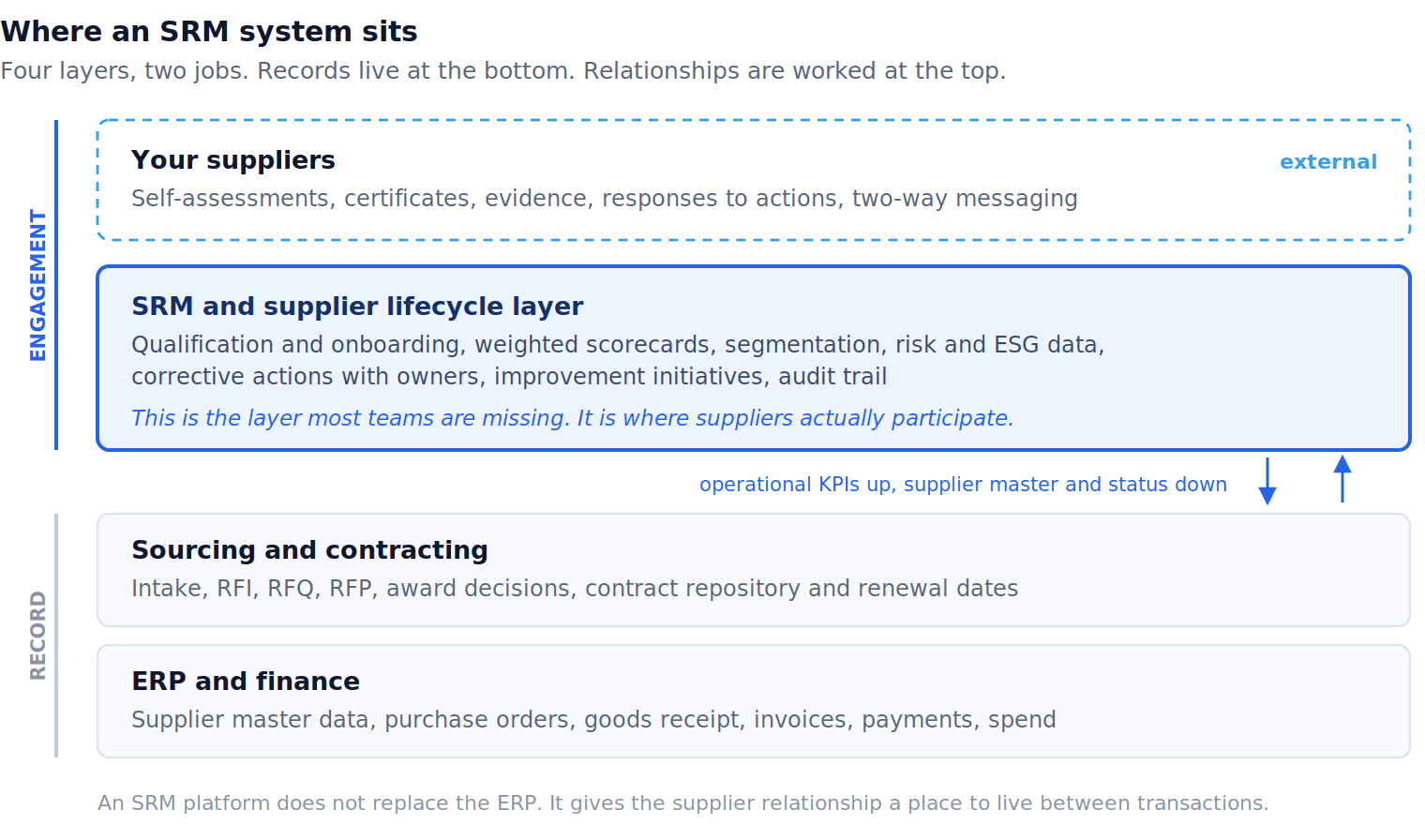
The layer diagram matters for one commercial reason. When the CFO asks why the ERP cannot do this, the honest answer is that the ERP holds transactions and master data brilliantly and has no concept of a relationship, a review cycle, or a supplier who needs to be persuaded to answer a questionnaire. Those live in a different layer, and it is a layer where supplier collaboration is the point rather than a side effect.
3. Which category do you actually need
Run this before you build a shortlist. It takes ten minutes and it disqualifies half the market.
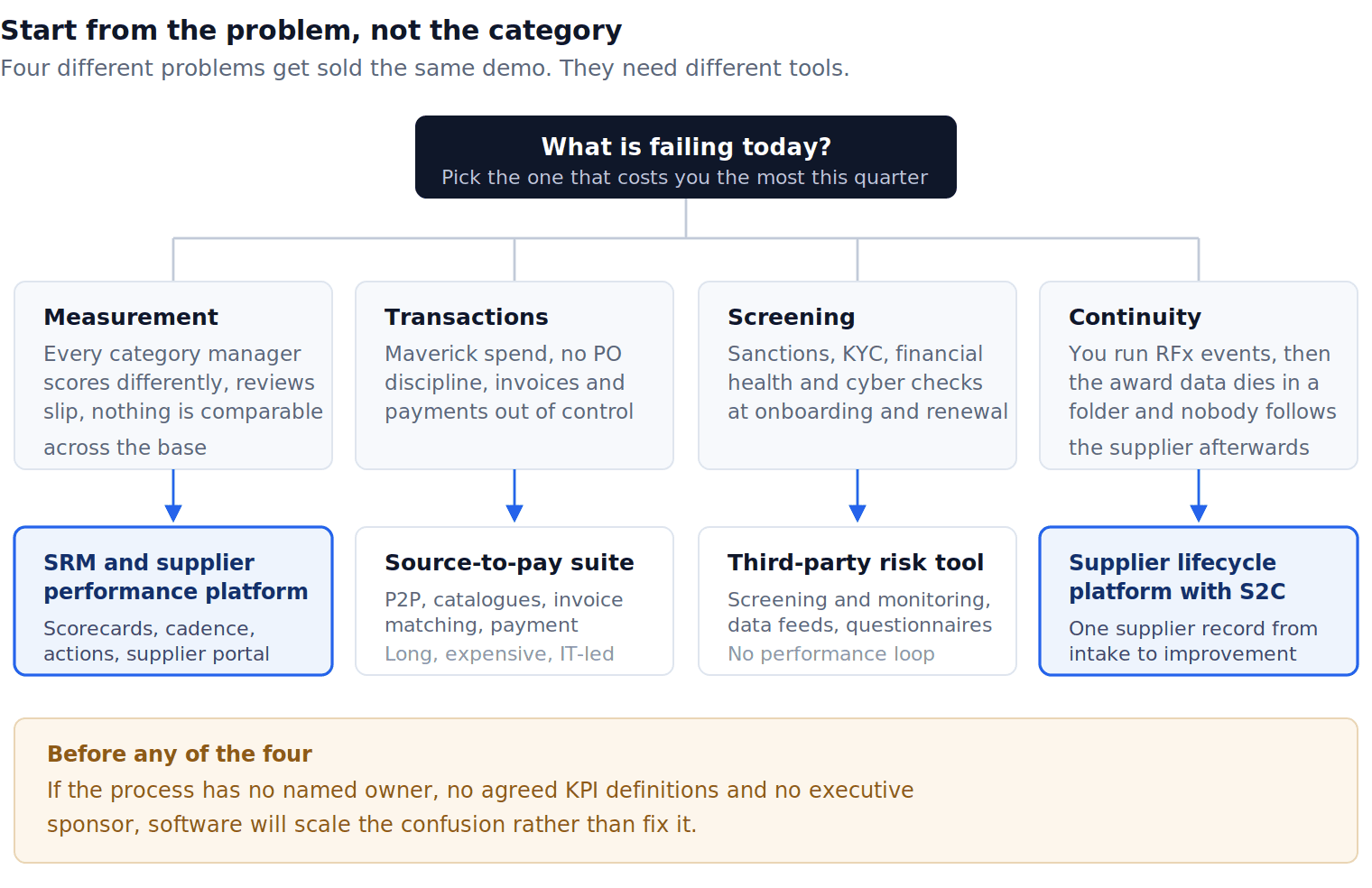
A note on combinations. Many mid-market teams discover they have two of these problems at once, typically measurement and continuity: they run sourcing events and they have inconsistent scorecards, and the award data never reaches the people who manage the supplier afterwards. That combination is the specific reason supplier lifecycle platforms exist, and it is worth asking whether one supplier record across sourcing and performance would remove more work than two best-of-breed tools with an integration between them. Our view on where sourcing tools end and lifecycle management begins goes deeper on that boundary.
4. The twelve criteria that predict success
These are ordered by how strongly they correlate with a programme still running two years later. The weights are a starting point. Adjust them, but keep the top four dominant, because they are the ones that fail silently.
01 Supplier-side adoption
The single most common cause of a stalled programme is that suppliers do not respond. Everything downstream depends on data arriving from organisations you do not employ, do not train and cannot discipline easily. Ask to see the supplier experience, not the buyer experience: the invitation email, the first login, the mobile view, the language options, what happens when the wrong person receives it, and how a supplier submits a certificate.
Evidence to demand: a live supplier-side login during the demo, plus the vendor’s actual response rate data from comparable accounts. If the supplier portal costs extra per supplier user, treat that as a structural problem, not a pricing detail.
02 Who runs the cadence
A scorecard tool stores scores. An SRM system runs the calendar: it sends the evaluation on schedule, chases the people who have not answered, escalates when a deadline passes and aggregates the result without anybody copying anything. The difference is roughly one full-time equivalent of administrative work per few hundred suppliers, and it is the difference between a programme that survives a busy quarter and one that quietly stops.
Evidence to demand: show me the reminder and escalation configuration, and show me the log of what the system sent last month without a human involved.
03 Scoring flexibility, and whether you can change it yourself
Your scoring model will change. It always does, usually in month four when quality argues that defects should carry more weight than delivery. The question is whether that change costs an email to support and a change request, or ninety seconds in the interface. Look for weighted scoring where weights are set per evaluation method, different methods running on different cadences, and a consistent scale. We use a scale out of 10 throughout, because a mixed set of scales is where comparability dies.
Evidence to demand: change a weight, add a question and re-run a score during the demo, without the vendor saying “our team can configure that for you”.

04 Segmentation that actually changes the workflow
Sending a strategic supplier questionnaire to a stationery vendor is how you lose supplier goodwill and buyer time in one move. Segmentation, whether you use the Kraljic model from Peter Kraljic’s 1983 Harvard Business Review article or your own tiering, has to drive different templates, different cadences and different thresholds. Many tools let you tag a supplier as strategic and then treat it identically to every other supplier.
Evidence to demand: two suppliers in different segments, showing genuinely different questionnaires, review frequencies and alert thresholds.
05 The data model underneath
This is unglamorous and it decides whether the system still works in year three. Real supplier bases are messy: one legal entity with eleven plants, one group with three trading names, one contract covering four sites, one supplier that is also a customer. If the tool models a supplier as a single flat record, you will be creating duplicates within a month and your scores will not aggregate.
Evidence to demand: ask for the entity relationship model in writing. Suppliers to sites, sites to contracts, contracts to categories, users to roles. A vendor who cannot produce this quickly has not thought about it.
06 Closing the loop from score to action
A score with no consequence is a report. The system needs to turn a threshold breach into a task with an owner, a due date, required evidence and a verification step, then reflect the outcome in the next cycle. Ask specifically how the loop closes: who verifies, what evidence is stored, and whether the improvement is visible in the trend line.
Evidence to demand: follow one corrective action from trigger to verified closure in the product, including the supplier’s side of it.
07 Risk, certificates and sustainability data in the same record
Certificates expire, audits fall due, and sustainability questionnaires arrive from your own customers. If these live in a separate tool from performance, somebody reconciles two systems by hand. The practical test is whether an expiring ISO certificate can raise an alert and, if unresolved, affect the supplier’s status without a manual step.
Evidence to demand: an expiring certificate alert, and a sustainability questionnaire template you can edit rather than commission.
08 Integration realism
Ambitious integration plans are the most common cause of delayed go-lives. The mature pattern is to start with a file import of twelve months of history, prove the cycle works, then connect the systems that carry your operational KPIs. Ask what the vendor supports natively rather than what is technically possible, and get the effort estimate in days from someone who has done it. EvaluationsHub connects through native SAP and Salesforce sync via AWS AppFlow, a REST API with webhooks, and CSV or Excel import and export, which is documented on the integration capabilities page.
Evidence to demand: a named reference customer using the same ERP, and the field mapping document.
09 Governance, permissions and the audit trail
If procurement, quality, legal and finance all touch supplier data, you need role-based access with real segregation of duties, and an audit trail that records who changed a weight, who approved a score and when a document was uploaded. This is what turns your programme into evidence during an audit rather than an anecdote.
Evidence to demand: export an audit log. Look at whether it is readable by an auditor without a translator.
10 Pricing structure, not just price
Covered in detail in the next section, because it deserves it. In short: the unit a vendor charges on tells you what behaviour their product will encourage.
11 Security, hosting and exit
Ask where the data is hosted, under which certification, and how you get it out. EvaluationsHub is ISO/IEC 27001:2022 Certified, GDPR compliant and hosted on AWS in Paris (eu-west-3), with the detail on our trust center and data security page. Whoever you choose, put the exit clause in the contract at signature, not at renewal: full export of suppliers, scores, documents and audit history in a machine-readable format, on request, at no charge.
Evidence to demand: the certificate itself with its scope and validity dates, the data processing agreement, and a sample export file.
12 Time to first live score
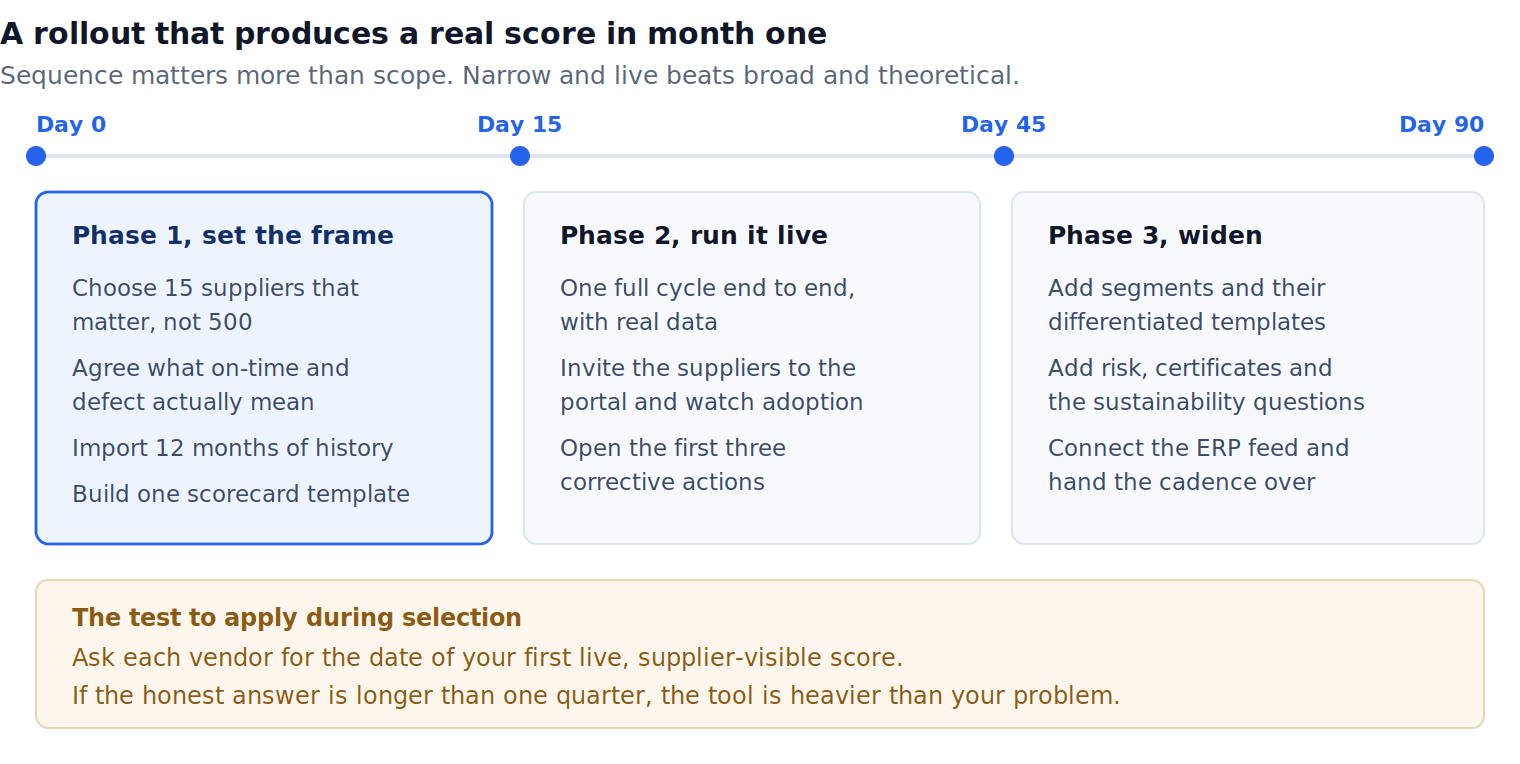
The best single predictor of a programme surviving is how quickly it produces something real. A pilot that scores fifteen suppliers in week three creates internal advocates. A nine-month configuration project creates fatigue and a change of sponsor. Ask every vendor for the date of your first supplier-visible score, and hold them to it in the contract.
| Criterion | Weight | Fails silently? |
|---|---|---|
| Supplier-side adoption and ease of response | 15% | Yes, six months in |
| Automated cadence, reminders and escalation | 15% | Yes, in the first busy quarter |
| Self-service scoring and template configuration | 12% | Yes, at the first model change |
| Segmentation driving differentiated workflow | 10% | Yes |
| Data model, entities, sites and hierarchies | 10% | Yes, in year two |
| Corrective action loop with verification | 10% | No, visible quickly |
| Risk, certificates and sustainability in one record | 8% | Partly |
| Integration effort and native connectors | 7% | No, visible at go-live |
| Governance, permissions and audit trail | 5% | Yes, at the first audit |
| Security, hosting, data residency and exit terms | 4% | Yes, at renewal |
| Total cost of ownership across three years | 2% | No |
| Time to first live score | 2% | No |
Two of those weights surprise people. Cost is deliberately low, because within a shortlist of credible platforms the price difference is usually smaller than the cost of a failed rollout. Time to first score is low as a weight but should be a hard gate: if it exceeds one quarter, the tool is heavier than your problem.
5. The pricing structure trap
The commercial model shapes the behaviour of your programme more than any feature. This is the part of SRM selection that almost nobody analyses properly.
Consider the most common model, per-user licensing. Multi-stakeholder scoring is the main defence against buyer bias: quality, operations, engineering, finance and the plant all see a different supplier, and the aggregate is far more accurate than one category manager’s view. Now price every one of those contributors at a few hundred euros a year. What happens is entirely predictable. Licences get rationed, participation narrows to procurement, and within a year you have an expensive single-scorer system with the same bias as the spreadsheet it replaced. Nobody decided this. The pricing model decided it.
| Model | Vendor incentive | Effect on your programme | Question to ask |
|---|---|---|---|
| Per named user | Grow seat count | Stakeholders excluded, scoring narrows to procurement, suppliers kept outside | What does it cost to add fifty occasional internal reviewers and every supplier contact? |
| Per supplier | Grow supplier coverage | Encourages participation, but tail suppliers can get expensive at volume | What is the price at 250, 500 and 1,000 suppliers, and is there a free tier for tail vendors? |
| Percentage of spend | Grow with your spend | Cost rises for reasons unrelated to the value delivered | What happens in a year when spend rises 30% and our usage is flat? |
| Module bundles | Bundle everything | You pay for modules you will not configure for two years | Can we buy the performance module alone and add sourcing later on the same supplier record? |
| Quote on request only | Price on perceived budget | Long cycles, weak internal comparison, renewal surprises | Will you publish the price list we are being offered, and cap year-two uplift in the contract? |
Our own answer to this is deliberate and structural rather than promotional: EvaluationsHub charges a platform fee plus a per-supplier fee that steps down with volume, with unlimited seats for internal users and supplier-side users, and the price list is published on the pricing page rather than gated behind a call. Unlimited seats is not generosity. It is the only pricing shape in which multi-stakeholder scoring survives contact with a budget holder.
6. Twenty-four questions to ask every vendor
Send these in writing before the demo and ask for written answers. The written answers are worth more than the demo, and the speed and specificity of the reply is itself a signal.
Supplier experience
- Show me the supplier’s first login, on a phone, in a language other than English.
- What percentage of invited suppliers complete their first evaluation, across your customer base?
- What does a supplier pay, and what do we pay per supplier user?
- Can suppliers see their own score and trend, or only our conclusion?
- How does a supplier submit evidence, and where is it stored afterwards?
Measurement and workflow
- Change a weight in front of me and re-run the score.
- Show me two segments with genuinely different templates and cadences.
- How are late responses chased, and by whom or by what?
- Show me a corrective action from trigger to verified closure.
- How do you aggregate scores from internal stakeholders and the supplier without one overwriting the other?
- Can a category, a plant and a group-level view all show the same underlying data correctly?
Data, integration and IT
- Send me the entity relationship model.
- Which connectors are native, and which require middleware or services?
- How do we import twelve months of history, and how long does that take in practice?
- Who owns the master supplier record if we also run a source-to-pay suite?
- Show me a sample export of everything we would take with us if we left.
Commercial and delivery
- What is our first supplier-visible score date, and will you write it into the order form?
- What is the total three-year cost including implementation, at our supplier count?
- What is the contractual cap on annual price increases?
- Which of your customers are closest to us in sector, size and supplier count, and may we speak to one without you present?
- What is your average implementation length for a customer our size, measured from signature to first live cycle?
Trust and continuity
- Which security certification do you hold, what is its scope, and when does it expire?
- Where is the data hosted, and can it stay in the EU?
- How many customers of our size have left in the last two years, and why?
On reference calls. Ask the reference one question that vendors cannot coach: “what does your team still do in a spreadsheet?” The honest answer maps the product’s real boundary far better than any feature list.
7. How to run the evaluation itself
Demos reward presentation skills. Pilots reward products. A structured pilot is the only reliable way to see what a platform is like on a Tuesday afternoon when a supplier has not replied and the plant manager wants an answer.
Run one full cycle, with your own data
Pick between five and fifteen suppliers that genuinely matter, including at least one that is currently underperforming. Load real history. Run one complete evaluation cycle end to end: send, chase, collect, score, review, open one corrective action, and close it. Anything a vendor pre-configures for you in a sandbox has been made to work in advance and tells you nothing about your Tuesday afternoon.
Score the pilot on process outcomes rather than impressions: response rate without human chasing, time from cycle start to complete scorecard, number of times you needed vendor support to make a change, and how many people outside procurement contributed a score. That last number is the one that predicts whether the programme has a future.
If you want to run that pilot with us. EvaluationsHub offers a free pilot with your own supplier data, up to three accounts and thirty seats, with no card and no commitment, at evaluationshub.co. If your current framework already lives in spreadsheets, we will rebuild it in the platform for you at no cost through white-glove onboarding, or you can book a working session with a procurement specialist rather than a sales development rep.
8. The full cost, not the licence fee
Build the three-year number before you negotiate, because it changes which vendor is actually cheapest surprisingly often.
| Cost line | Usually quoted? | What to ask for |
|---|---|---|
| Platform and per-supplier or per-seat licence | Yes | Price at your supplier count today and at plus 50% |
| Implementation and configuration | Sometimes | Fixed price, with the first live cycle as the acceptance criterion |
| Data migration and history load | Rarely | Whether import is self-service, and the format required |
| Integration build and maintenance | Rarely | Days of internal IT effort, plus who maintains the mapping |
| Internal administration | Never | Honest estimate of the ongoing admin load in days per month |
| Supplier onboarding effort | Never | Who writes the supplier communications, and in which languages |
| Training and turnover | Rarely | Cost of training a new category manager in year two |
| Annual uplift | Buried | A contractual cap, in writing, at signature |
| Exit and data extraction | Never | A no-charge full export clause in the contract |
On the benefit side, be conservative and specific. Tie the case to things you can evidence: hours of administrative work removed, cycle time reduction, avoided cost from a supplier issue caught early, and audit preparation time. Broad savings percentages are easy to quote and hard to defend in a business case review. If you want a worked example with real numbers from a manufacturer of around 3,200 employees, our case study on evaluation cycle time shows the arithmetic.
9. Buy for the durable driver, not the deadline
A large share of SRM projects in Europe over the past three years were justified by a compliance deadline. That is a fragile business case, and 2026 proved it. The EU’s Omnibus package, published in the Official Journal on 26 February 2026, narrowed mandatory CSRD reporting to companies above 1,000 employees and 450 million euro net turnover, with the new scope applying to financial years starting on or after 1 January 2027. The due diligence directive was narrowed further still, to companies above 5,000 employees and 1.5 billion euro turnover, with application pushed out to 2029. Many mid-market manufacturers who bought tooling for a 2026 reporting obligation now sit outside the direct scope entirely.
Here is the nuance that matters for your decision. Falling out of direct scope does not remove the work. Your large customers remain in scope, and they meet their obligations by asking you and your suppliers for data. That flow does not depend on your own headcount. The same applies to the requirements that were never in the Omnibus at all: ISO 9001 clause 8.4 requires documented criteria for the evaluation, selection, monitoring and re-evaluation of external providers, and retained records of those activities and the actions arising. Automotive suppliers face the same expectation through IATF 16949. Those obligations are stable and they are the ones to build your case on.
The other durable driver is capacity. The Hackett Group’s 2026 Procurement Key Issues research found procurement workloads rising while headcount and operating budgets edge down, with technology spend expected to absorb the gap. If your team is being asked to cover more suppliers with the same people, automation of the collection and follow-up loop is a capacity argument, and capacity arguments survive changes in regulation and changes in sponsor.
Practical translation. Write the business case on administrative capacity and audit evidence. Treat sustainability reporting as a capability you will need whichever way the rules move, rather than as the deadline that justifies the purchase.
10. Red flags and green flags
Red flags in a vendor process
- The demo never shows the supplier’s side of the product.
- Every configuration change is answered with “our team can set that up for you”.
- Pricing is only available after a discovery call, and the quote arrives without a unit price.
- Reference customers are offered only with the vendor on the call.
- The implementation plan measures progress in workshops rather than in live cycles.
- Claimed integrations turn out to mean “possible via API” with no customer live on it.
- The audit trail exists but cannot be exported in a form an auditor would accept.
Green flags
- They ask about your supplier segmentation before they ask about your budget.
- They are specific about what the product does not do.
- They offer a pilot with your data rather than a longer sandbox trial with theirs.
- Written answers come back fast and match what the demo showed.
- They will commit to a first live score date in the order form.
- Published pricing, or at least a published structure.
11. Where EvaluationsHub fits, and where it does not
We build one of the platforms in this market, so treat this section as informed rather than neutral, and hold it to the same tests as everyone else’s.
EvaluationsHub is a supplier lifecycle platform with source-to-contract capability. The evaluations module covers weighted scorecards, multi-stakeholder scoring, segmentation, risk and sustainability data collection, corrective action workflows and a white-labelled supplier portal that carries your brand rather than ours. The initiatives module covers intake, RFI, RFQ, RFP, contracting, onboarding and improvement programmes. Both modules run on one shared supplier record, and they can be bought independently. Founded in 2021 by Vockam SAS in Paris, the platform is used by more than 350 procurement teams, holds a 4.9 out of 5 rating on G2, is ISO/IEC 27001:2022 Certified and GDPR compliant, and is hosted on AWS in Paris.
Three design decisions are worth putting next to the criteria above. Seats are unlimited on both the internal and the supplier side, which is what makes multi-stakeholder scoring economically survivable. The cadence is run by the platform, which sends, chases, escalates and aggregates without procurement doing the chasing. Pricing is published rather than quoted. Where we go further than most scorecard tools is the shared cross-buyer supplier portal, which means a supplier already onboarded for another buyer is not starting from zero with you.
Where we are not the right answer. If your primary problem is requisitions, purchase orders, invoice matching and payment, you need a source-to-pay suite, and we do not handle POs, invoicing or payments by design. If you need continuous automated screening of sanctions lists, beneficial ownership and cyber posture as your central use case, a specialist third-party risk platform will do that better. If you manage twenty-five suppliers with one buyer, a well-designed spreadsheet and a recurring calendar invitation genuinely is enough, and we would rather say so than sell you a platform you will abandon.
Sector-specific detail lives on the pages for automotive, food and beverage, medical devices, pharma, specialty chemicals, aerospace and IT services. Consultancies running supplier programmes on behalf of clients should start with the advisory firms page.
12. The ten-step selection checklist
- Write the problem statement in one sentence, in the CFO’s language.
- Confirm the process owner and the executive sponsor by name.
- Agree KPI definitions with quality and operations before you shortlist.
- Use the decision tree to pick the category, then shortlist three vendors, not seven.
- Send the written questions before any demo.
- Score against a weighted matrix your stakeholders agreed in advance.
- Run a real pilot with your own data and at least one underperforming supplier.
- Model the three-year total cost, including internal administration.
- Negotiate the first live score date, the uplift cap and the exit clause together.
- Go live narrow, prove one cycle, then widen. Do not launch with 500 suppliers.
Templates for the scoring model itself, including weighted scorecard structures you can adapt, are in our SRM template library, and the longer strategic background is in the whitepapers.
13. Frequently asked questions
What is an SRM system?
An SRM system is software that manages the ongoing relationship with suppliers: qualification and onboarding, performance scorecards, risk and sustainability data, corrective actions, improvement plans and the collaboration between buyer and supplier. It complements the ERP, which records transactions and master data, by holding everything that happens between transactions.
What is the difference between SRM and SPM?
Supplier performance management is the measurement engine: KPIs, weighted scorecards, evaluations and corrective actions. Supplier relationship management is the wider discipline that includes measurement plus segmentation, governance, collaboration and development. In software terms, SPM is a module inside an SRM platform.
Can we not just use our ERP?
An ERP holds supplier master data and transaction history, both of which you need. What it generally does not provide is a supplier-facing portal, scheduled multi-stakeholder evaluations, weighted scoring configurable by segment, or a corrective action loop with evidence and verification. Most teams keep the ERP as the system of record and add an SRM layer above it.
How much does an SRM system cost?
Mid-market platforms are typically priced as a platform fee plus a per-supplier or per-user fee, and land somewhere between roughly 20,000 and 120,000 euro a year depending on supplier count and modules. The larger variable is implementation, which ranges from included to several times the annual licence. Always model three years including internal administration time, and get any annual uplift capped in the contract.
How long does implementation take?
A focused rollout should produce a first live, supplier-visible score inside a quarter, with a narrow first scope of ten to twenty suppliers. Full deployment across several hundred suppliers, multiple segments and an ERP integration usually runs six to nine months. If a vendor’s honest first-score date is beyond one quarter, the tool is probably heavier than the problem.
How many suppliers do you need before an SRM system is worth it?
There is no universal threshold, but the practical trigger is usually somewhere above 50 to 100 actively managed suppliers, or fewer than that when a small number of suppliers carry high risk, as in medical devices or aerospace. Below roughly 25 suppliers with one buyer, a disciplined spreadsheet and a calendar reminder is often the honest answer.
What is the most common reason SRM implementations fail?
Suppliers not responding, followed closely by nobody owning the cadence internally. Both are process failures that software can mitigate but not cure. This is why supplier-side experience and automated chasing should carry more weight in your selection than analytics or dashboard design.
Should we buy a suite or a best-of-breed SRM platform?
Buy the suite if your dominant problem is transactional control and your IT function will resource a long programme. Buy best-of-breed if your dominant problem is measurement, governance or administrative load, and you want a first live cycle this quarter. A common and sensible pattern is an S2P suite for transactions with a dedicated SRM layer above it for relationships and performance.
Do we still need sustainability data collection after the EU Omnibus changes?
Very probably, even if you are now outside the direct reporting scope. Companies that remain in scope satisfy their obligations by requesting data from their value chain, so mid-market suppliers continue to receive questionnaires from their customers. Build the capability, but write the business case on capacity and audit evidence rather than on a specific reporting deadline.
What should a supplier scorecard actually contain?
Between four and seven weighted evaluation methods, each on its own cadence, scored on one consistent scale, with weights summing to 100 percent and differentiated by supplier segment. Typical methods are on-time delivery, quality, compliance or audit results, responsiveness, cost performance and sustainability. Each method needs an agreed definition and a named data source before the first cycle.
