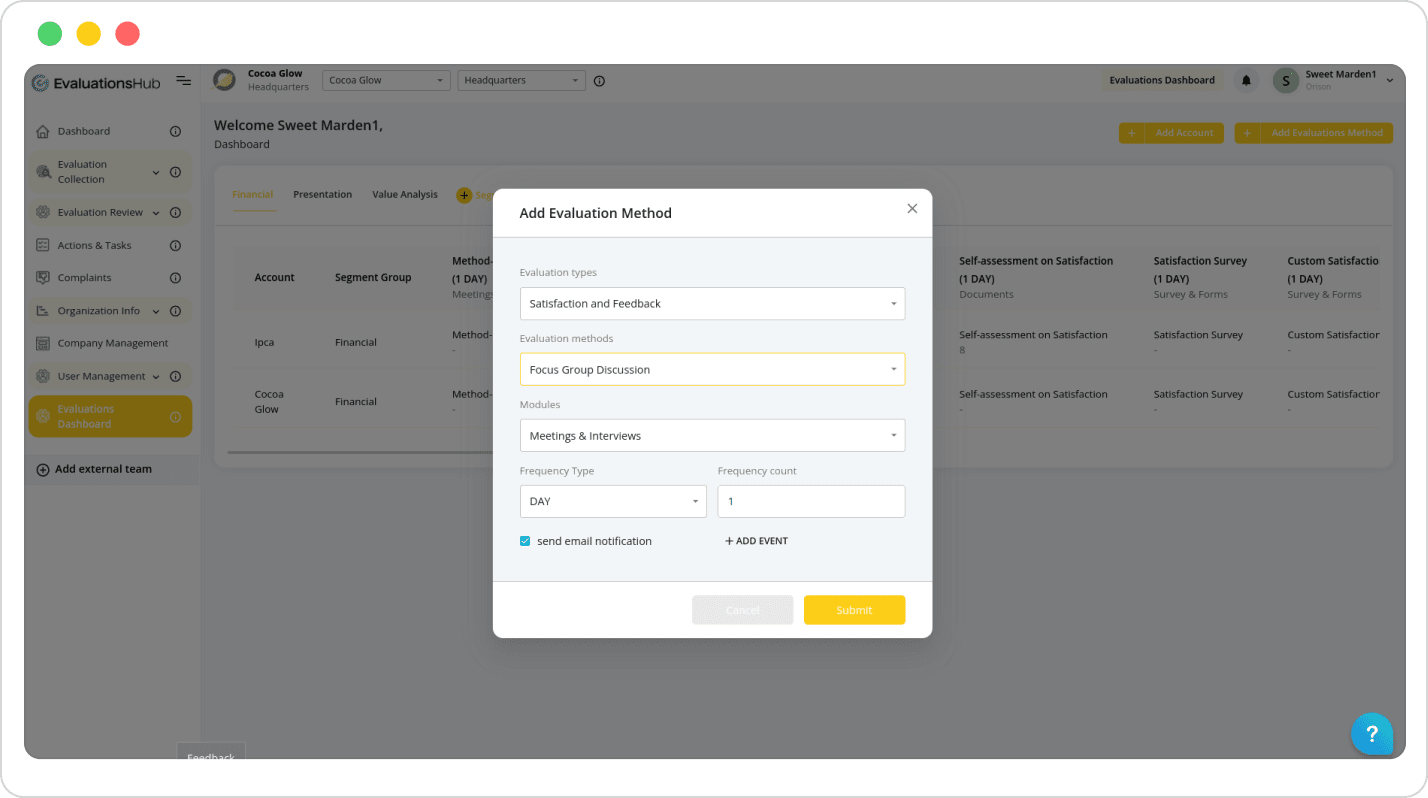
Which Platform Delivers Feedback That Actually Drives Action?

When it comes to collecting customer or stakeholder feedback, GetFeedback (by Momentive, formerly SurveyMonkey) is a popular name. It’s designed for survey creation and distribution, especially around customer experience metrics like CSAT, NPS, or CES.

But if you’ve ever tried to manage supplier scorecards, track post-project evaluations, or automate stakeholder input across departments, you know: surveys alone are not enough.

That’s where EvaluationsHub comes in.

If you want to transform feedback into a structured, automated, and accountable evaluation process—across suppliers, customers, and teams—EvaluationsHub is built for you.


GetFeedback: A Good Survey Tool, With Limited Reach

GetFeedback is easy to use and integrates with Salesforce. It’s great for simple transactional surveys and dashboarding key CX metrics. But it’s not designed for procurement, supplier collaboration, or internal audit workflows.

  • No built-in evaluation logic

  • No action tracking

  • No automated scorecard aggregation

  • No templated audit loops across external or internal users

It’s a classic survey tool. You get data—but you do all the work after.


EvaluationsHub: Built to Automate Feedback, Scorecards, and Impact

EvaluationsHub isn’t a survey tool—it’s an evaluation system.

It allows you to:

  • Build multi-question templates for any evaluation use case (supplier, customer, internal)

  • Automate score aggregation, reminders, and actions

  • Push evaluations to external vendors or internal teams

  • Track outcomes and build audit trails

Whether you’re running ISO audits, supplier evaluations, onboarding reviews, or ESG assessments, EvaluationsHub turns fragmented survey chaos into one clear workflow that actually gets followed.


Side-by-Side Comparison: GetFeedback vs. EvaluationsHub

Feature/Capability GetFeedback EvaluationsHub
Platform Type CX & survey platform Evaluation automation platform for procurement, CX, compliance
NPS/CSAT/CES Surveys ✔️ Yes – native templates ✔️ Yes – can integrate or run natively
Supplier Scorecards ✖️ No ✔️ Core feature – automated scoring & reporting
ISO/ESG/Onboarding Evaluations ✖️ No ✔️ Yes – built-in templates & audit support
Multi-Stakeholder Input ✖️ Limited ✔️ Push evaluations across departments, vendors, customers
Score Aggregation ✖️ Manual or via BI ✔️ Automated scoring and reporting
Reminders & Follow-Ups ✖️ Not built-in ✔️ Fully automated
Branded Evaluation Portals ✖️ No ✔️ Yes – external-facing and customizable
Closed-Loop Action Tracking ✖️ No ✔️ Yes – per evaluation, per question
Salesforce Integration ✔️ Deep integration ✔️ Possible via Make.com or direct integrations
Time to Deploy Quick for surveys Quick for structured evaluations
Pricing Per response/seat-based Transparent modular pricing + free managed account

Why EvaluationsHub Is More Than a Feedback Tool

GetFeedback ends at data collection. EvaluationsHub begins there.

Instead of sending surveys and analyzing the results yourself, EvaluationsHub:

  • Runs the full process of collecting, scoring, analyzing, and closing the loop

  • Automates evaluations for procurement, sustainability, customer onboarding, or post-project follow-up

  • Gives you the ability to assign ownership, track accountability, and improve performance across ecosystems

Whether your stakeholder is a supplier, customer, internal team, or audit partner—EvaluationsHub gives you a consistent, automated framework to manage that feedback at scale.


Conclusion: Surveys Are a Start. EvaluationsHub Finishes the Job.

If you only want to send out NPS surveys, GetFeedback is a clean solution.
But if you want to run real evaluations, push feedback cycles to suppliers or teams, aggregate results, and trigger improvement actions—EvaluationsHub is in a different class.

It’s not a prettier survey tool.
It’s a strategic execution platform for evaluations across your entire value chain.


Start for Free – Not a Demo, a Real Use Case

EvaluationsHub offers one fully managed account for free—so you can experience the platform live, not in a sandbox.

👉 Launch your first structured evaluation today

Which Platform Drives Real Customer & Supplier Accountability?

In the world of B2B relationship management, ClientSuccess and EvaluationsHub are often seen in overlapping conversations—but they serve very different purposes. While both platforms are built around improving long-term partnerships, the way they do it—and the value they deliver—couldn’t be more different.

ClientSuccess focuses on customer success teams managing renewals, QBRs, and account health. It offers playbooks, alerts, and basic surveys.

But when you need to run structured evaluations with customers or suppliers, automate scoring, and manage accountability across internal and external stakeholders—EvaluationsHub is in another league.


ClientSuccess: A Good Fit for Basic Account Management

ClientSuccess is a solid tool for customer success managers who want to track customer health, centralize notes, and trigger alerts before churn risks appear. It provides playbooks, task lists, and integrations with CRMs.

However, it’s not designed for:

  • Cross-departmental evaluations

  • Supplier scorecards

  • ESG or risk audits

  • ISO or compliance initiatives

  • Structured feedback collection at scale

In short, it’s a CS dashboard, not a platform for evaluations and improvement cycles.


EvaluationsHub: Structured Feedback Engine for CX, Procurement & Quality Teams

EvaluationsHub doesn’t stop at a health score. It gives you the tools to evaluate, act, and improve relationships—whether with customers, suppliers, or internal teams. From sustainability audits to onboarding evaluations to post-project feedback, it allows you to:

  • Push evaluation templates to dozens (or hundreds) of stakeholders

  • Automate reminders and scoring

  • Collect structured feedback internally and externally

  • Track actions and close the loop

  • Offer a branded portal experience to customers or vendors


Side-by-Side Comparison: ClientSuccess vs. EvaluationsHub

Feature/Capability ClientSuccess EvaluationsHub
Target Users Customer Success Managers Procurement, Quality, Sustainability, CX & CS Teams
Use Case Focus Account health tracking End-to-end evaluations & feedback across stakeholders
Customer Health Scores ✔️ Yes ✔️ Possible, via score aggregation
Supplier Scorecards ✖️ No ✔️ Yes – fully automated and flexible
Push Templates at Scale ✖️ No ✔️ Push to customers, suppliers, or internal users in bulk
Feedback Collection ✔️ Basic NPS or CSAT ✔️ Deep, structured evaluations with multi-dimensional scoring
Closed-Loop Accountability ✖️ Task-based only ✔️ Built-in action tracking and ownership per response
Branded Evaluation Portals ✖️ No ✔️ Yes – offer a white-label experience
Project Feedback (CX, onboarding) ✖️ Not supported ✔️ Yes – includes post-onboarding, post-initiative, and project assessments
ISO/ESG/Risk Templates ✖️ No ✔️ Yes – supports procurement and compliance needs
Time to Value Weeks Days – live immediately with minimal setup
Pricing SaaS pricing, team-based Modular, includes one fully managed account for free

EvaluationsHub Is Built for More Than Just “Success”—It’s Built for Impact

ClientSuccess helps CSMs manage churn risk. But EvaluationsHub helps your whole business manage performance risk. It works across departments—procurement, compliance, quality, sustainability, and customer experience—to:

  • Run proactive evaluations

  • Identify issues before they become churn

  • Hold stakeholders accountable

  • Improve satisfaction, delivery, and results—automatically

Whether you’re a manufacturer evaluating suppliers, a SaaS company collecting onboarding feedback, or a CX team running post-project surveys, EvaluationsHub gives you what CRMs and CS tools cannot: a centralized evaluation engine with automated insights.


Final Thoughts

ClientSuccess is ideal if you just need a way to remind yourself to follow up with clients.
EvaluationsHub is for teams who want to run evaluations that lead to real change.

From ESG audits to supplier onboarding and customer scorecards, EvaluationsHub is your all-in-one solution to drive improvement—not just monitor relationships.


Try it Free – No Demo Wall, Just Real Value

EvaluationsHub offers one fully managed account for free—no strings attached. Not a sandbox, but an actual working experience in your live environment.

👉 Start your evaluation journey now

Always Improving

The beginning of every year offers businesses an opportunity to reflect, assess performance, and plan ahead. For B2B managers, this period is not only about financial reviews or operational metrics but also about answering a critical question: Are we meeting the needs of our clients, and how can we do better next year?

Customer feedback is the bridge between your assumptions and reality. Without it, businesses risk misaligning their efforts with client expectations, leading to dissatisfaction and potential churn. Collecting customer feedback is more than a good practice; it’s a strategic tool for sustained growth, especially in the B2B space where relationships and long-term partnerships are paramount.

Here’s why collecting feedback annually—or even more frequently—should be a cornerstone of your strategy, and how tools like EvaluationsHub can make the process seamless and impactful.


The Importance of Annual Customer Feedback

In B2B, customer feedback is not just about understanding satisfaction; it’s about uncovering actionable insights that drive improvement. Consider this scenario:

A manufacturing supplier might assume that delivery speed is their primary competitive advantage. However, feedback from key clients reveals that inconsistent packaging quality is a more pressing issue. Without actively soliciting feedback, this supplier would have focused on the wrong area, risking client dissatisfaction and a damaged reputation.

Why is feedback so critical for B2B managers?

  1. Improving Customer Retention
    B2B relationships are built on trust and long-term value. Annual feedback surveys help businesses identify pain points before they escalate, ensuring that clients feel heard and valued. For example, a software vendor using EvaluationsHub might discover that their clients struggle with onboarding due to insufficient training materials—insights that lead to tailored training programs.
  2. Identifying New Opportunities
    Feedback often uncovers unmet needs. For instance, a logistics company might learn that clients need predictive analytics to optimize their supply chain, leading to the development of new value-added services.
  3. Driving Innovation
    By understanding shifting client priorities, businesses can stay ahead of competitors. Consider a professional services firm that learns through annual feedback that their clients are increasingly prioritizing ESG (Environmental, Social, and Governance) compliance. They can adapt by offering specialized ESG consulting packages.
  4. Strengthening Relationships
    Listening and acting on feedback builds stronger connections. A client who sees their suggestions implemented is more likely to remain loyal and recommend your services to others. Tools like EvaluationsHub allow you to centralize and track feedback, ensuring nothing falls through the cracks.

What Makes Customer Feedback Especially Crucial in B2B

The stakes are higher in B2B than in B2C because:

  • Contracts are larger and longer-term. Losing one client can have a significant financial impact.
  • Decision-makers are diverse. Feedback often comes from multiple stakeholders, such as procurement managers, operations teams, and C-suite executives.
  • Customization matters. B2B clients expect solutions tailored to their unique needs.

Feedback is your best chance to uncover insights from all relevant stakeholders, ensuring you’re meeting diverse expectations.


The Best Tools for Gathering B2B Customer Feedback

Customer feedback tools must be tailored to the B2B environment, where interactions are more complex. While Net Promoter Score (NPS) is a popular metric, combining it with other tools provides a more comprehensive view. Below are some top tools and how they apply to B2B:

1. Net Promoter Score (NPS)

  • How it Works: NPS asks clients how likely they are to recommend your business on a scale of 0-10.
  • B2B Example: A consulting firm tracks NPS scores for each department they serve (e.g., HR, finance) to understand which teams are the most satisfied.
  • Using EvaluationsHub: NPS responses can be automatically tagged to specific accounts, making it easy to identify areas needing attention.

2. Customer Satisfaction Score (CSAT)

  • How it Works: CSAT measures satisfaction with specific interactions, such as service calls or product deliveries.
  • B2B Example: A logistics company gathers CSAT scores after each shipment, helping them track trends and address recurring issues.
  • Using EvaluationsHub: CSAT surveys can be integrated into your project workflows, ensuring every touchpoint is measured.

3. Customer Effort Score (CES)

  • How it Works: CES assesses how easy it is for clients to interact with your business, such as resolving issues or placing orders.
  • B2B Example: A SaaS provider uses CES to measure how quickly and easily clients can access support documentation.
  • Using EvaluationsHub: CES data is visualized in dashboards, highlighting friction points for immediate action.

4. Stakeholder-Specific Feedback

  • How it Works: Gather feedback from individual stakeholders, such as procurement, operations, and executives.
  • B2B Example: A manufacturing supplier customizes surveys for procurement teams to focus on cost efficiency, while operations teams are asked about product performance.
  • Using EvaluationsHub: The platform allows stakeholder segmentation, ensuring feedback is relevant to each group.

Best Practices for Collecting Feedback in B2B

To maximize the value of customer feedback, follow these best practices:

1. Tailor Your Surveys

B2B clients often have complex needs. Generic surveys won’t capture the nuances.

  • Example: Instead of asking “How satisfied are you with our services?”, ask “How satisfied are you with the lead times for Product X?” or “How effective is our team at resolving your queries?”
  • Pro Tip: EvaluationsHub offers customizable survey templates tailored to B2B industries.

2. Focus on Key Accounts

Not all clients are equal. For key accounts, go beyond standard surveys and schedule detailed reviews.

  • Example: A chemical supplier conducts quarterly reviews with their largest clients, discussing challenges and goals in addition to survey results.

3. Act on Feedback

Collecting feedback is pointless unless it leads to action.

  • Example: An IT services provider learns that clients are frustrated with response times. By investing in a dedicated support team, they improve satisfaction and increase renewal rates.
  • Using EvaluationsHub: Assign follow-up tasks directly from survey insights to ensure accountability.

4. Share Results Transparently

Clients appreciate knowing their feedback has been heard.

  • Example: A marketing agency shares a summary of survey results and their planned actions with clients, reinforcing trust.

How EvaluationsHub Simplifies Feedback Collection and Action

EvaluationsHub is designed specifically for B2B managers who want to streamline their feedback processes. Here’s how it stands out:

1. Centralized Feedback Management

All feedback—whether it’s NPS scores, CSAT results, or detailed comments—is stored in one place, accessible to all relevant team members.

2. Automated Workflows

Transform feedback into action by automating next steps. For instance, when a client rates their satisfaction below a threshold, a follow-up task is automatically assigned to your account manager.

3. Custom Reporting

EvaluationsHub provides in-depth reports segmented by accounts, regions, or industries, helping you uncover trends and make data-driven decisions.

4. Integration with Existing Tools

Whether you use Trello, Salesforce, or ClickUp, EvaluationsHub integrates seamlessly, ensuring feedback fits into your current workflows.


Real-World Example: A B2B SaaS Provider

A SaaS company managing over 200 enterprise clients used EvaluationsHub to collect quarterly NPS and CES scores.
The result?

  1. They discovered that clients with CES scores above 7 were 3x more likely to renew their contracts.
  2. By addressing the most common complaint—lack of user training—they reduced churn by 20%.
  3. Automated feedback summaries allowed account managers to focus on solutions rather than data entry.

Conclusion

Customer feedback is the key to unlocking growth and innovation in B2B businesses. By tailoring your approach and using tools like EvaluationsHub, you can transform feedback into actionable insights, building stronger relationships and staying ahead of competitors.

Ready to take your feedback strategy to the next level?
Sign up for a free trial of EvaluationsHub and discover how easy it is to collect, analyze, and act on customer feedback.